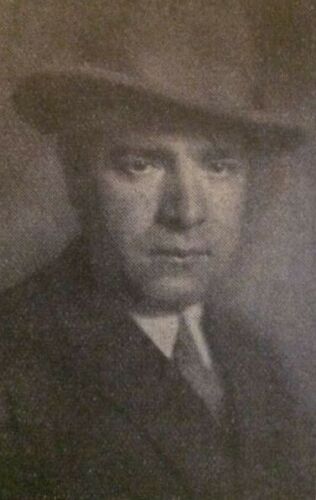
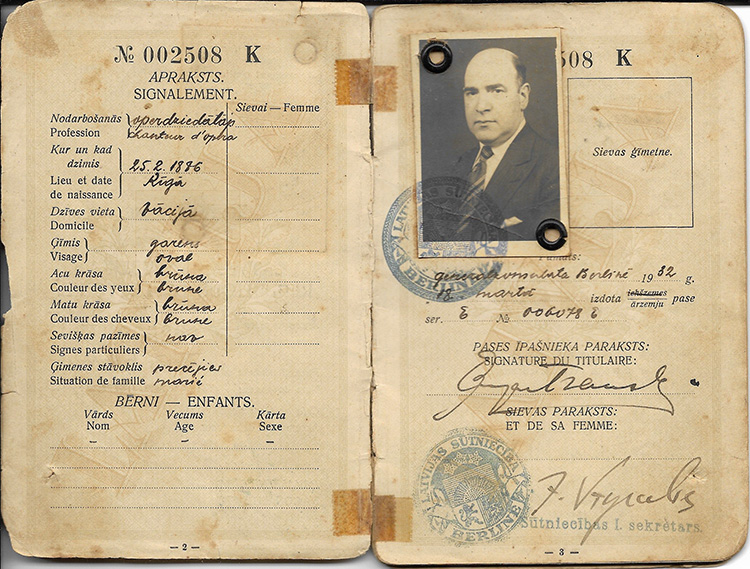
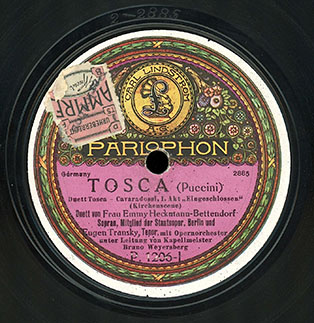
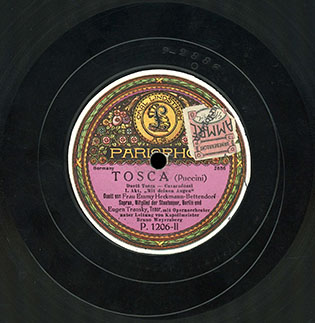
Eugen Transky was Latvian (which does not go without saying for somebody born in Riga!)
and Jewish, his real name was Aiziks Tabačniks. He spent his entire career in Germany, and not
at major theatres: Thorn (today Polish Toruń), where he made his debut in 1910; Nürnberg, Breslau (today Polish
Wrocław), Gera, Volksoper Berlin, the early Berlin radio (1926–30).
The most interesting period in his life (though the most unfortunate for him, no doubt)
came after the Nazis took power: as long as they thought it might be useful to placate the
international public opinion, they entertained the Jüdischer Kulturbund, in a way the Jewish
equivalent to the Reichskulturkammer – the corporate association whose member every artist
had to be by law in order to be allowed to work. Jewish artists, of course, were not admitted
to the Reichskulturkammer – they had to join the Jüdischer Kulturbund instead. And the Jüdischer
Kulturbund even ran a small opera theatre in Berlin, with Jewish artists only, and for the
Jewish public only – Transky was one the "stars" of this bizarre enterprise, though his career
was in fact over, already before 1933. He later managed to escape to Rio de Janeiro, where he
was teaching; he later lived (and died) in São Paulo.
The Jüdischer Kulturbund opera, to
complete also this history, performed as long as 1941,
and this must really have been a place capable of turning one's love of opera into hatred
and despair – a false front of "normal life", while all the artists and visitors involved were
in fact living in midst of terror, expulsion, murder, and inhumanity.
Reference 1,
Reference 2
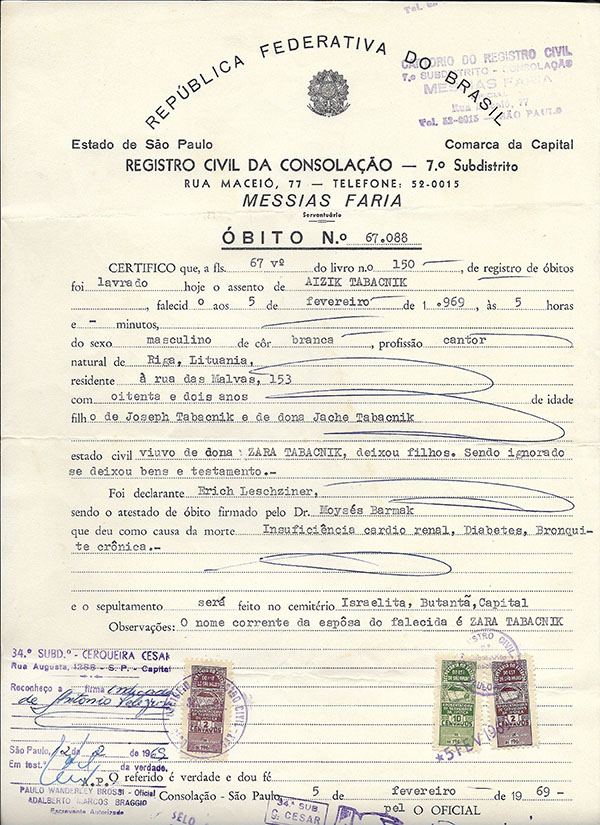
A thousand thanks to Transky's grandson Manfredo Harri Tabacniks for copies of Transky's documents, and thus for
clarifying his dates of birth and death.
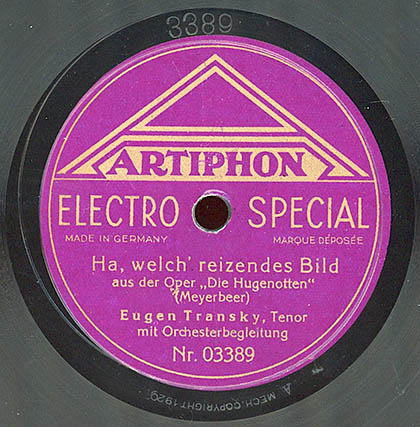
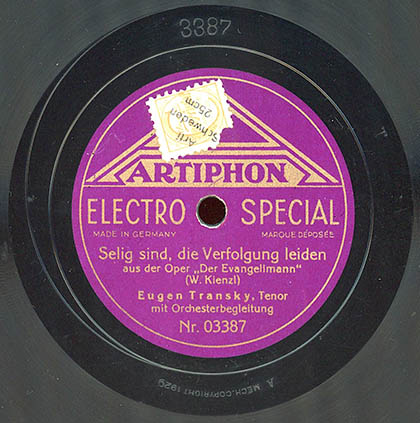
Many thanks to Anton Bieber for the Huguenots, Evangelimann and Tosca recordings & label scans.