Auguste Yché
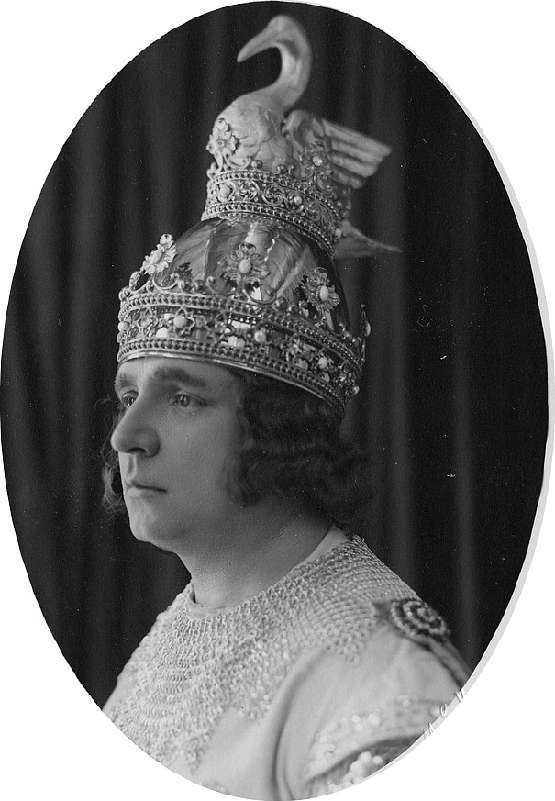 This is a tenor that must have been very well-known at his time, since contemporary French newspapers are brimming with reviews of his performances – reviews that are almost unanimously excellent. Particularly his easy top was regularly praised, which is surprising if you hear below what may well be his only record. Yché was a vintner, who got his probably first exposure as a tenor at age 29, in a competition organized by the music magazine Comoedia, where he earned a third prize (11 June 1920). Early in his career, but I don't know whether it was his very first contract, he was a member of the Montpellier opera theater. In September 1922 at Pamiers, Yché participated in an open-air performance of La fille de la terre by Déodat de Séverac. In winter 1922/23, he was a member of the troupe in Avignon, appearing as Pinkerton for instance. In March 1923, he sang Cavaradossi in Bayonne and had to repeat "E lucevan le stelle" twice (the third time, he sang it in Italian). April found him in Béziers for Sigurd. For the 1923/24 season, he belonged to the troupe in Nantes, scoring a triumph at the season opening in October as Sigurd. In November and December, he was a guest in Angers, singing Vasco da Gama and Samson, respectively, and he returned as Cavaradossi in March. At some point in the first half of the 1920s, he must also have sung at La Monnaie in Brussels, because around that time in France, he was regularly announced as "de La Monnaie" – that theater's history being particularly poorly documented, though, it's impossible to know what he sang there and when. In September 1924 in Céret, another open-air performance of La fille de la terre; in October, Yché was in Avignon for Africaine, and next, making his debut as Samson, in Bordeaux, where he returned one year later for Sigurd, Messaline, La favorite and Rigoletto. In winter 1924/25, he was at the Capitole in Toulouse for the first time, and very successful in Messaline, before stealing the show as Sigurd in Dijon in April 1925. In January 1926, he was busy singing Hélion in Messaline at the Marseille Opéra as well as at the Capitole in Toulouse, where he was also Lohengrin and stayed into February. In March, he sang Vasco da Gama, Lohengrin and Zamella in Le gardian (by Bienvenu Molinetti) as a guest in Algiers. In May and June, he appeared at the Théâtre Antique in Arles in Messaline, and in July in Avignon as Sigurd and in Trets in an open-air production of Le gardian. October of the same year saw him at the Marseille Opéra as Raoul, where he also sang Turiddu and Duca in November and participated in a new production of Antar by Gabriel Dupont in December, before going to Toulouse for a series of performances. January to March 1927, he was in Marseille for Tosca, Rigoletto and Faust as well as in Grenoble for Hérodiade (January), in Toulouse for Africaine and Quo vadis? (both in January) and Boris Godunov (February, singing Grigorij), and in Aix-en-Provence for La favorite (March); in April in Marseille again for Werther. For the winter season 1927/28, he was hired by the Nice opera theater. In June 1928, he was Samson at the open-air Arènes de Béziers, and in Marseille, another series of open-air performances that same summer featured him in Le gardian, while it was Aix-les-Bains's turn in August 1928 (Lohengrin). The same month, he sang Werther in an open-air production in La Ciotat, and Siegmund at the huge but short-lived open-air Théâtre de Verdure in Saint-Aygulf near Fréjus. While appearing mostly in the south of France, he ventured into Lille in October 1928 as Vasco da Gama. In May 1929, he sang Berlioz' Faust in Limoges. In fall of the same year, he sang Lohengrin and Siegmund in single-act performances on Radio Paris, then he opened the season in Avignon; in December, he was at the Capitole in Toulouse and appeared in Messaline. In January 1930, he went to Limoges for Favorite and Rigoletto; in February and March in Bordeaux, he impersonated Vasco da Gama, Fernand, Éléazar, Cavaradossi, Lohengrin and Tannhäuser. Yché spent the winter season 1930/31 in Nice, where he had considerable success in Walküre, Siegfried, Götterdämmerung, Aida, Hérodiade, Samson et Dalila, Le chant de la cloche (by Vincent d'Indy), La damnation de Faust (with Marcel Journet and Mireille Berthon) and Il trovatore. Immediately before going to Nice, he had been in Nantes for Jean and Sigurd, much acclaimed. October 1930 found him in Nantes as Jean; November in Bayonne as Fernand and Don José. He was back to Montpellier for another Fernand in March 1931, and in December 1932 for Éléazar. October 1931 excursions brought him to Angers for Gounod's Faust and for Jean, and to Algiers (where he had already sung before, but I don't know when) for Messaline. Then, he spent the 1931/32 season at the Marseille Opéra, and was very successful there singing Pedro in Tiefland, Sigurd, Jean, Éléazar, Radamès, Samson, Cavaradossi, Fernand and Grigorij. November 1932 found him in Avignon, again as Fernand. In 1933 and 1935, he sang at the Paris Opéra (Lohengrin, Éléazar and Samson). He was Lohengrin in Nancy in December 1933, stepping in for José de Trévi, who didn't get the required leave from the Paris Opéra. In March 1934 in Metz, he sang Tannhäuser, and the same month, he got a really bad review (which he rarely did, as we know) for a Sigurd in Bordeaux. In December 1933 and January 1935 in Paris, he participated in concerts by artists from the Hérault region, where he had been born. In December 1935, he was back to Bordeaux, singing Fernand. He also appeared a few times in Tours in the 1930s: as Fernand in December 1933, as Jean in October 1934, as Siegmund in February 1937, and as Radamès in March 1938, which is also the last public appearance of Yché that I could trace. He died during Christmas Eve midnight Mass at the church in his native Colombiers while singing "Noël".
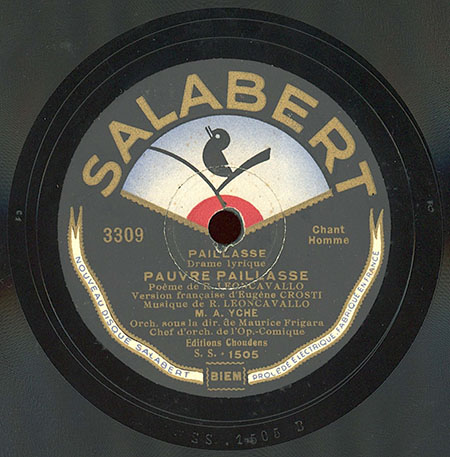
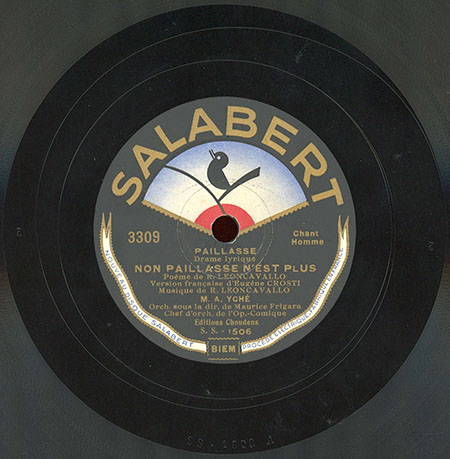
References: I wish to thank Anton Bieber for the recordings and label scans. |