Hans Lissmann
19 September 1885 Hamburg – 26 May 1964 Leipzig
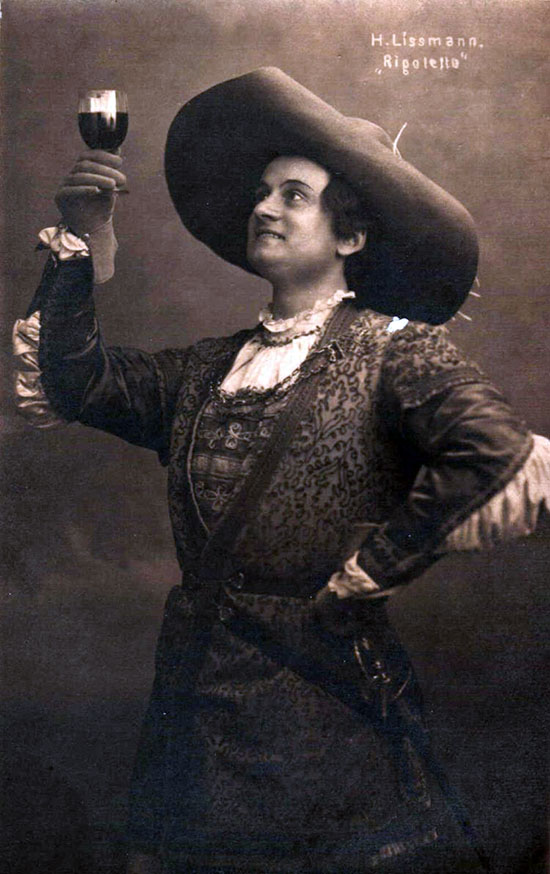
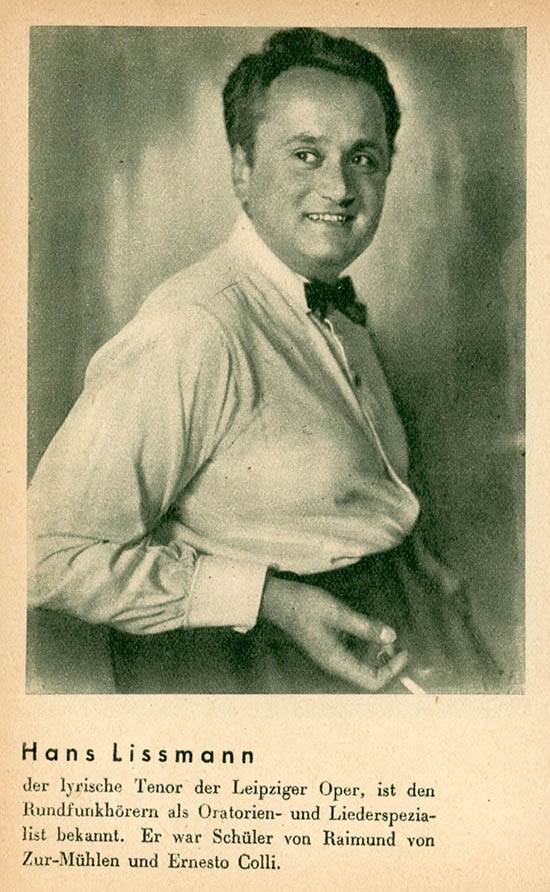
His parents were singers (bass-baritone Friedrich Heinrich Lissmann and soprano Anna Marie Lissmann-Gutzschbach), and his
sister was a singer, too (concert soprano Eva-Katharina Lissmann). He studied music at the conservatories in Leipzig (with Arthur
Nikisch, among others) and Dresden; then he worked as an opera conductor. Eventually, he studied voice in London and Milano (with
Ernesto Colli).
Lissmann made his debut in Italy, where he sang with touring opera companies; in 1913, he returned to Germany, and sang at the Hamburg
Volksoper for a short while. From 1914 to 1933, he was first lyrical tenor in Leipzig; already from 1923, and through 1954, he taught
voice at the Leipzig Conservatory.
He participated in four world premieres: Mona Lisa by Max von Schillings (Stuttgart, 26 September 1915),
Revolutionshochzeit by Eugen d'Albert (26 September 1919), Clavigo by Max Ettinger (19 October 1926), and Aufstieg und
Fall der Stadt Mahagonny by Kurt Weill (9 March 1930). Other than that, his repertory included Belmonte, Châteauneuf, Haroun
(Djamileh), Max, Alfredo, Fenton, Italienischer Sänger, Elis (Der Schatzgräber by Franz Schreker) or the title
role in Jean de Paris by Boieldieu. He sang a lot of concert music, notably Bach's oratorios. And he composed songs as well as
operas, the best-known of which was Weh dem, der lügt.
Reference 1; reference 2: Kutsch & Riemens
Picture source

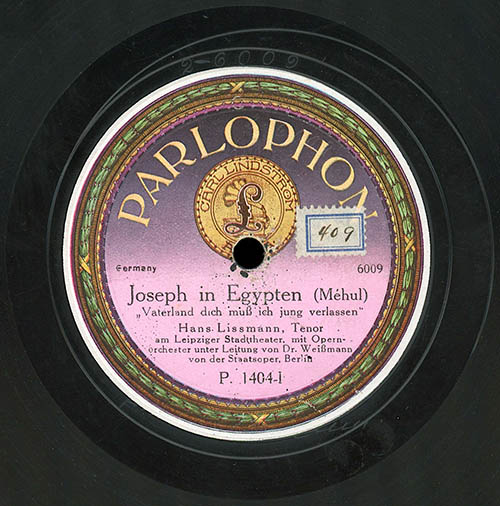
Discography
Parlophon, Berlin, 12 September 1922
2-6009	Joseph (Méhul): Vaterland				P1404
2-6010	Così fan tutte (Mozart): Un'aura amorosa		unpublished
2-6011	Zauberflöte (Mozart): Dies Bildnis ist bezaubernd schön	P1404
2-6012	Werther (Massenet): Ah non mi ridestar			unpublished
2-6013	Don Giovanni (Mozart): Tränen, vom Freund getrocknet	unpublished
Anton Bieber has provided the recordings and label scans, and a picture (second from top, source: Künstler am
Rundfunk. Ein Taschenalbum der Zeitschrift Der deutsche Rundfunk, Berlin 1932): thank you!
|