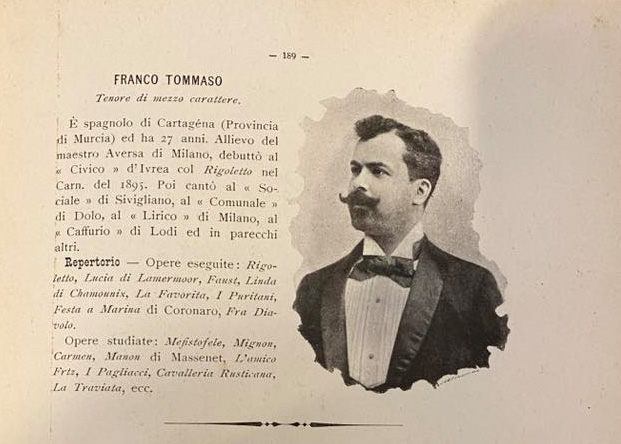
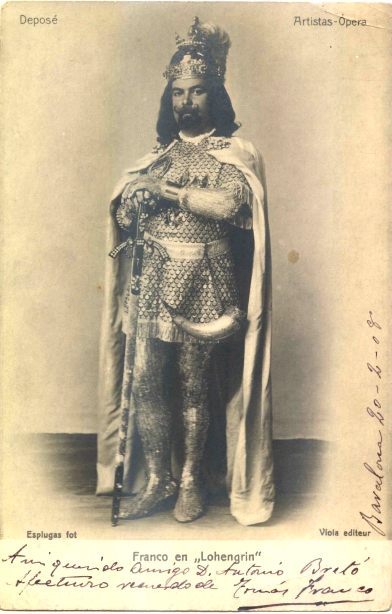
Tomás Franco studied voice in Milano with maestro Aversa and made his debut in the Carnival season 1895 at the Teatro Civico
in Ivrea, as Duca di Mantova. He had an uneventful career in Italy as Tommaso Franco (Sivigliano, Perugia, Lodi, Dolo, the Teatro
Lirico in Milano, the Bellini and the Fiorentini in Napoli, Ravenna, Trento, Sampierdarena, Busto Arsizio, Alessandria) –
and a good one in Spain: at the Liceu in Barcelona, he sang in 1898 and a lot in 1899 (Gounod's Faust, Duca, Turiddu, Edgardo,
Arturo in Puritani, Elvino, Laërte), and if the catalogue of Viuda de Aramburo cylinders pictured below didn't
lie, "Señor Franco" also appeared at the Teatro Real in Madrid.
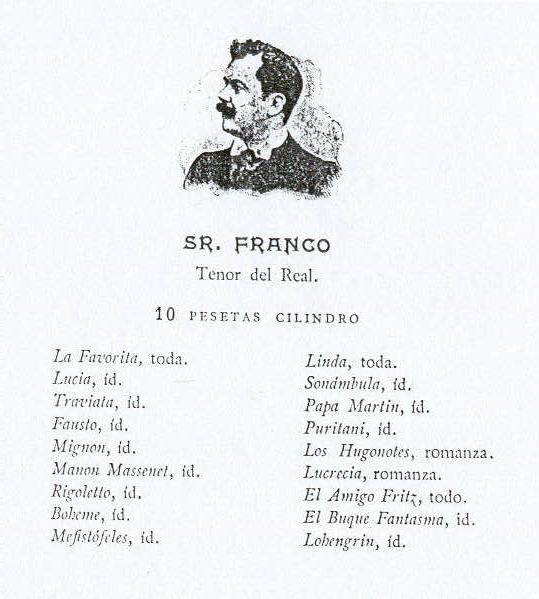
The probability that any specimen of these ultra-rare cylinders still exists is devastatingly low.
But there are more recordings by Señor Franco:
Hugens y Acosta cylinder (unnumbered), Madrid, between 1898 and 1901
	El canto del presidiario (Álvarez)

Odeon, Madrid, 1908 (?)
xS829	Aragón (trad)							unpublished
									(test pressing exists)
Hugens y Acosta was another of those phonograph cylinder producers in Madrid in the late 1890s, coeval to the Viuda de
Aramburo cylinders; and that cylinder is not known thanks to any catalogue, but to a surviving copy owned by the Spanish
National Library. They provide a transfer of the cylinder on their website; a transfer that is another excellent reason to despair
about human intelligence. At almost four half-notes sharp, both the announcer and the singer sound like Mickey Mouse on Speed...
Well, a transfer done without switching off brain and ears would very much sound like this:
The sound quality, both as far as original recording and as far as cylinder wear, leaves a whole lot to be desired; but what can be clearly
discerned is a highly individual, almost unique timbre. Weightless, exceptionally bright, yet by no means unmanly, with a very weak low
register and a not-too-easy top, it's a short voice, but imbued with a haunting, bittersweet melancholic quality: what the voice is lacking in
compass, the singer makes up for with the extraordinarily distinctive sound that he produces, and with outstanding musicality.
Quite surprising that a tenor of this quality spent most of his career at relatively nondescript theaters!
And his career seems to have been short to boot. In summer 1902, he toured Saint Petersburg (not at any prestigious theater,
but at the Akvarium), Vilnius and Łódż with an Italian Mignon production, and after that, I find him only
on two more occasions, at the Teatro Apollo in Lugano in May 1904, again in Mignon; and in Girona, where he sang several
performances in October and November 1906. (Of course, he may have pursued his career in Spain, and we may just be lacking
information about it; Spain's operatic history is far poorer documented than Italy's.)
And then, there are cylinder recordings made by one Signor Franco in Italy in 1909:
Edison cylinders, Napoli (?), January 1909
20566	Amor ti chiedo (Cimino)						20566
20567	La tua stella (Mascagni)					20567
20568	La serenata (Tosti)						20568
20596	Alla mente confusa (Tosti)					20596
20597	Chiarastella (de Cristofaro)					20597
Now Tomás Franco's career would seem to have been over for years when these cylinders were made, and Franco is of course
anything but a rare name; so Edison's Signor Franco could very well be a different singer. Two of those cylinders are in the
possession of the University of California, Santa Barbara (USCB), and available on their website. Albeit those are excellent
transfers, they add to the despair about human intelligence nonetheless... Roberto Marcocci attributed them, no doubt without having
been able to hear any of them, to soprano Emma Franco. Ok. But the USCB maintained that attribution, and classifies them as "female
vocal with orchestra"... no kidding?
Well... no random namesake! The voice is clearly aged, the top has become a bit labored; but it's still the same rare timbre,
the same haunting melancholy, and the same close-to-inexistent low register (particularly evident in the Cimino song, which is a
trifle, by the way, and yet lingers in the memory thanks to this stupendous interpretation). So Edison's Signor Franco is again
Tomás Franco, this time probably four-and-a-half years after his retirement from stage.
This is confirmed by two more Edison cylinders, whose numbers (and hence recording dates and places) are unknown:
	Bohème (Leoncavallo): Io non ho che una povera stanzetta	cat. no. unknown
									(two takes existing)
They are (two takes of the same aria) in the possession of the New York Public Library (unfortunately, not available online), and
though the boxes give "Sig. Franco", once again, a leaflet inside clearly identifies "Tommaso Franco".
By the way, Franco was an almost perfect lookalike of Franco Cardinali, and
his surname was identical with Cardinali's Christian name... so when first discovering the cylinders and picture of "Señor
Franco", I was totally convinced that this was a record pseudonym of Franco Cardinali. I've been proven wrong by two expert
collectors in the "Cantanti Lirici in 78 Giri" Facebook group; they didn't deem the whole thing worth of contacting and informing me
(cooperation is just an unknown concept to too many people), but fortunately, I soon discovered their discussion by pure chance, and
in spite of their weird refusal to communicate, I'm very grateful for their valuable research.
Reference 1 and picture source (top two): Facebook group "Cantanti Lirici in 78 Giri"; reference 2:
A. Lombardo, Annuario dell'Arte Lirica e Coreografica Italiana 1897–98, Milano 1898; reference 3: the fantastic website of Roberto Marcocci; reference 4: UCSB Cylinder Audio Archive;
reference 5: Biblioteca Nacional de España; reference 6: Gesellschaft für historische Tonträger, Wien; reference 7; reference 8